Thursday, April 16, 2009

Tail Wheel Landings Trial II

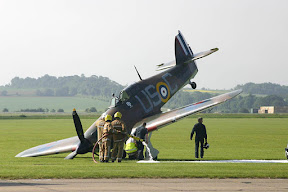
Ground LoopA few days ago, I went up for some tailwheel landings and was really happy with my progress. I couldn't wait to go up the next day and do some more landings to see if I could solidify the muscle memory. So, yesterday, I did go do some more tailwheel landings and boy did it ever suck!

I bounced it around pretty good the first few attempts and got so flustered that I couldn't even read my altimeter (let alone hold pattern altitude). It may have been the worst flying I've ever done.

Now, I know that everybody has bad days, but for the life of me I couldn't figure out how it ended up that bad. Well, the fact is that flying a tailwheel airplane is tough to do. Some very good pilots have been groundlooped by a gusty wind. Everybody goes through this with conventional gear.

I also think I'm at a disadvantage because of my tricycle gear experience. Thing is, at this point, a 20 to 30 knot gusting and variable crosswind doesn't really phase me. In fact, it doesn't even make my palms sweat anymore.

So, when I showed up at my tailwheel school, my instructor asked, "are you sure you want to go? 22 knots is pretty fast." Of course, I thought, "yeah, 22 knots mostly down the runway is no big deal! Let's go."

Well, several really tough approaches and landings later, I gave up for the day. Sitting in the flight school, the owner of the plane said, "I can't believe you tried today. I usually don't fly with wind above 4 or 5 knots." My instructor said when he bought his first taildragger, he wouldn't go above 7 or 10 knots. It helped to know that 22 knots is a lot of wind in a taildragger.

So, I have two tips for the conventional gear hopeful. First, don't get discouraged! Flying a taildragger is really hard. Second, a little wind changes things a lot in a taildragger. It is good to get the high wind experience, but count on some rough times and remember how much time you had to get in your tricycle gear trainer before you were comfortable with a heavy crosswind.

Have fun. Be safe. Happy Piloting.
I really appreciate comments so please feel free to comment on my posts. Whether you agree or disagree, I'd love to hear from you. Also, feel free to link back to your own blog in your comments. You can even subscribe to an RSS feed of the comments on this thread.

© 2008 — , D. Patrick Caldwell, Vice President for Research and Development, Emerald Software Group, LLC

Passenger Lands Twin King Air

Twin King AirDoug White, a SEL private pilot landed a twin turbo King Air after his pilot enroute.

Doug thanked god for getting him and his family through the ordeal. The controller who talked Doug down was on the wire with a friend of his who was rated in the King Air.

The news article about Doug's tale includes two soundbytes about the event.

Attaboy Doug!

Have fun. Be safe. Happy Piloting.
I really appreciate comments so please feel free to comment on my posts. Whether you agree or disagree, I'd love to hear from you. Also, feel free to link back to your own blog in your comments. You can even subscribe to an RSS feed of the comments on this thread.

© 2008 — , D. Patrick Caldwell, Vice President for Research and Development, Emerald Software Group, LLC

Wednesday, April 15, 2009

Tailwheel Landings in an 8KCAB

Patrick with CubI got to fly a little yesterday after almost 3 months without logging a single hour. I'm about 12 hours shy of being able to solo the Super Decathlon. That, of course, is not the only benefit of doing some tailwheel work.

Every time I fly a conventional gear airplane, I notice that all of my landings improve (even my tricycle gear landings). Taildraggers give you much less leeway in your landings so every landing is either a good one or it is not a landing at all. In a tricycle gear plane, however, you can bounce that thing onto the runway and walk away just hoping nobody noticed. If you screw up in a taildragger, you'll end up (as my flight instructor said), swapping ends.

So, how'd it go?

Well, I made 14 landings. I had 2 really good wheelies and 2 really good three point landings. It hasn't clicked yet. So far, it is still really cognitive. I very effortfully make each landing and I think that I may be over thinking it. I've gotten into the habit of making smaller control inputs in the hope that I won't over correct so much.

With the wheel landings, I level off a bit too high and I keep holding it off instead of letting it settle so I get too slow and my rate of descent starts increasing again and sure enough I touch down and that tail drops and I'm flyin' again.

With the three pointers, I tried to nose it over to get it to land (which is obviously wrong) and I wasn't quite in three point position so sure enough, I touched down, the tail dropped and I was airborne.

I want to make sure it becomes subconscious so I'm going to go do landings again today. Hopefully, it won't be quite so windy. That was another factor. Landings are harder with the wind and at a busy airport so I suppose with this much effort spent in unfavorable conditions, when I do have good weather, it'll be a piece of cake.

I'll keep you posted :).

Have fun. Be safe. Happy Piloting.
I really appreciate comments so please feel free to comment on my posts. Whether you agree or disagree, I'd love to hear from you. Also, feel free to link back to your own blog in your comments. You can even subscribe to an RSS feed of the comments on this thread.

© 2008 — , D. Patrick Caldwell, Vice President for Research and Development, Emerald Software Group, LLC

Tuesday, April 7, 2009

Fireworks From the Air

VideoA few friends of mine and I decided to fly around and watch fireworks from the sky. It was a lot more fun than sitting there in a dirty parking lot watching it. Then we flew around looking for Lake Lanier but couldn't find it. Not because of the drought, but because all of boats with their lights on looked like cars.


This video was recorded by a passenger (not the pilot) and no regulations were violated during filming.

Have fun. Be safe. Happy Piloting.
I really appreciate comments so please feel free to comment on my posts. Whether you agree or disagree, I'd love to hear from you. Also, feel free to link back to your own blog in your comments. You can even subscribe to an RSS feed of the comments on this thread.

© 2008 — , D. Patrick Caldwell, Vice President for Research and Development, Emerald Software Group, LLC

Flying Over Sanford Stadium in Athens, GA

VideoI was flying into Athens, GA (KAHN) for the after game day party and lucky for me, runway 9 was active. I was vectored in for a straight in final . . . right over Sanford Stadium.


This video was recorded by a passenger (not the pilot) and no regulations were violated during filming. I was vectored through the TFR by ATC for the final approach to the active runway.

Have fun. Be safe. Happy Piloting.
I really appreciate comments so please feel free to comment on my posts. Whether you agree or disagree, I'd love to hear from you. Also, feel free to link back to your own blog in your comments. You can even subscribe to an RSS feed of the comments on this thread.

© 2008 — , D. Patrick Caldwell, Vice President for Research and Development, Emerald Software Group, LLC

Soloing a Rental Aerobatic Airplane

Fiona the Super DecathlonI've flown with about 6 or 7 different flight schools since I started flying. They all have their ups and downs. Some have the best instructors, others have the best prices.

Sky Bound Aviation at PDK in Atlanta is the only one I've found where not only can you get affordable aerobatic training, but after about 25 hours of dual received, you can solo their decathlon.

I'm about 10 or 15 hours into it and I can't wait to have an opportunity to share my love of aerobatics with my friends and family.

Thanks Evanthe! I really appreciate it.

Have fun. Be safe. Happy Piloting.
I really appreciate comments so please feel free to comment on my posts. Whether you agree or disagree, I'd love to hear from you. Also, feel free to link back to your own blog in your comments. You can even subscribe to an RSS feed of the comments on this thread.

© 2008 — , D. Patrick Caldwell, Vice President for Research and Development, Emerald Software Group, LLC

Saturday, April 4, 2009

Dealing with Directional Gyro Failure

Directional GyroWhen you start working on earning your private ticket, you're under the fortunate circumstance that you don't know anything. You're a clean slate. Every time you go fly, you learn something new and exciting while you build your piloting skills.

When you start working on your multi-engine, however, you focus almost exclusively on engine failures. In fact, you pretty much focus solely on the failure of the left engine (for most twin airframes . . . you'll know what I mean). When you start working on your instrument ticket, it's about 50-50.

You spend the first 20 hours learning to read new charts and approach plates. You get better at your communication and you get to talk a lot more. The next 20 hours you spend shooting approach after approach under various circumstances. Your instructor will pull breakers on you left and right. What if your GPS doesn't work? Your DME? Your AI or DG? Etc.

One of the exercises I did with my instrument instructor was to try to fly enroute and shoot an approach with a failed DG. He taught me a trick that really helped me and could help all pilots instrument rated or not.

Compass errors (oscillation, acceleration, and northerly-turning) make navigating by magnetic compass a royal P.I.T.A. Even if you fully understand compass errors and you remember your catch phrases ("overshoots north / undershoots south" and "accelerate north / decelerate south"), it still feels like navigating by trial and error.

Fortunately, there is in my opinion, a vastly better alternative. If you are making a heading change, take a look at your current magnetic bearing. Calculate the number of degrees between your current and target bearings. Divide that number by 3 and that's the number of seconds it'll take you to turn to your desired heading at standard rate.

I glazed over that so I'll go through a specific example. You're at straight and level flight heading 090. You want to turn to heading 180. That's 90 degrees to the right. A standard rate turn is 3 degrees per second so it'll take 30 seconds to make the turn.

To be sure, you'll still have to make a few course corrections here and there, but that will get you much closer than guessing what the magnetic compass should read at roll out. Also, there's a really easy way to calculate the time it takes to perform the turn. Take a look at your DG or OBS. Find your current heading on the card. If your OBS not in use, you can even turn it to indicate your current heading. Then, count the number of major divisions (30 degrees).

In the above example, there would be 3 major divisions between 90 and 180 (90-120, 120-150, 150-180). That's 30 seconds. Then, add a little more than 3 seconds for each minor division (10 degrees).

For example, if you're flying 065 degrees ENE and you want to turn to 340 degrees NNW, count 2 major divisions (060-030 and 030-360) for 20 seconds. Add to that 2 minor divisions (360-350 and 350-340) for another ~7 seconds (we can ignore the 5 degree half tick between 060 and 065 but if you're really concerned about it you can tack on another second for good measure).

Have fun. Be safe. Happy Piloting.
I really appreciate comments so please feel free to comment on my posts. Whether you agree or disagree, I'd love to hear from you. Also, feel free to link back to your own blog in your comments. You can even subscribe to an RSS feed of the comments on this thread.

© 2008 — , D. Patrick Caldwell, Vice President for Research and Development, Emerald Software Group, LLC